

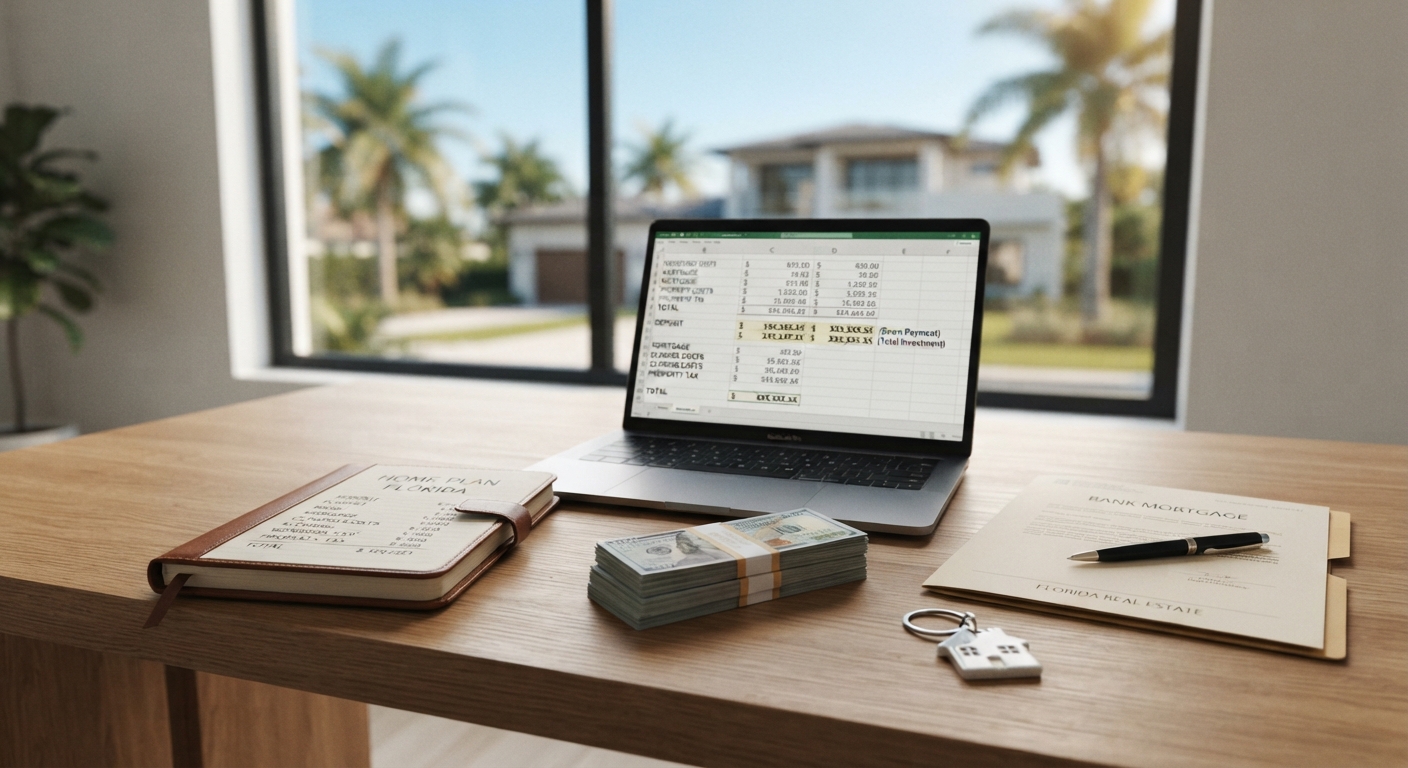
The 20% myth may be costing you time
If you are looking at a $350,000 home and believe you need $70,000 just for the down payment, you may be eliminating yourself before you understand your options.
Yes, putting 20% down is one way to purchase a home.
It is not the only way.
Qualified buyers may have access to conventional financing with as little as 3% down, FHA financing with 3.5% down, and VA or USDA programs that may require no down payment at all. Florida also offers assistance programs that can help eligible buyers cover part of their down payment or closing costs.
That does not mean every buyer will qualify for every program—or that buying a home requires no preparation.
It means you should understand your financing path before deciding homeownership is out of reach.
There Is No Universal Number
The amount of money you need will depend on several factors:
- The purchase price.
- The loan program.
- Your income and monthly debts.
- Your credit profile.
- Whether the home will be your primary residence.
- The property type and location.
- Property taxes and homeowners insurance.
- HOA or CDD fees.
- Available down payment assistance.
- Seller concessions or builder incentives.
- The financial reserves you want to keep after closing.
That is why the better question is not simply:
“How much do I need for the down payment?”
The better question is:
“How much cash will I need to close—and what will this home cost me every month?”
A lender may approve a number. Your life still has to support it.
The Four Buckets of Money You Should Plan For
1. The Down Payment
Your down payment is the portion of the purchase price that is not covered by your mortgage.
Depending on your eligibility and loan program, that amount may be:
- 3% with certain conventional loans.
- 3.5% with an FHA loan.
- 0% with an eligible VA loan.
- 0% with an eligible USDA loan.
- A higher percentage if you choose to reduce the amount financed or if your loan scenario requires it.
A larger down payment may lower your loan amount and, in some cases, reduce mortgage insurance costs.
But using every dollar you have for the down payment is not always a smart strategy.
Buying the home and having nothing left for repairs, moving costs or emergencies is not financial security. It is simply a new address for your stress.
2. Closing Costs
Closing costs may include lender charges, title services, recording fees, appraisal costs, prepaid taxes, homeowners insurance and other expenses associated with the transaction.
Freddie Mac estimates that closing costs commonly range from approximately 2% to 5% of the purchase price, although the actual amount will depend on the property, lender, loan and transaction.
Depending on the situation, part of these expenses may be covered through:
- A down payment or closing cost assistance program.
- Negotiated seller concessions.
- Builder incentives.
- Permitted lender credits.
- Gift funds when allowed by the loan program.
These possibilities should never be assumed.
A builder incentive can look impressive in an advertisement and become much less impressive once you review the interest rate, financing requirements and restrictions. The complete numbers matter more than the headline.
3. Upfront Transaction Expenses
You may also need money available before closing for expenses such as:
- Earnest money.
- A general home inspection.
- Specialized inspections, when needed.
- The appraisal, depending on how the lender collects the fee.
- Insurance quotes or other property evaluations.
Earnest money is generally credited toward the funds due at closing, so it is not necessarily an additional cost. However, you may need to provide it soon after your offer is accepted.
4. Post-Closing Reserves
Do not build your entire plan around reaching the closing table with exactly zero dollars left.
You may need funds for:
- Moving expenses.
- Immediate repairs or maintenance.
- Appliances or essential furniture.
- Utility deposits.
- Insurance changes.
- An unexpected personal expense.
The goal is not simply to buy a home.
The goal is to own it without making every unexpected repair feel like a financial emergency.
What Would This Look Like on a $350,000 Home?
The following examples are for educational purposes only. They are not loan estimates or financing offers.
Financing scenario | Estimated down payment | Estimated closing costs | Illustrative upfront total* |
Conventional with 3% down | $10,500 | 7,000–17,500 | 17,500–28,000 |
FHA with 3.5% down | $12,250 | 7,000–17,500 | 19,250–29,750 |
Conventional with 5% down | $17,500 | 7,000–17,500 | 24,500–35,000 |
Eligible VA or USDA with 0% down | $0 | 7,000–17,500 | 7,000–17,500 |
*Before inspections, moving expenses and reserves—and before applying any eligible assistance, seller credits or builder incentives.
This example shows why there is no universal answer.
Two buyers can purchase homes at the same price and need very different amounts of cash.
One may use a 3% conventional loan. Another may qualify for a Florida assistance program. An eligible veteran may use VA financing. Another buyer may find a qualifying home in a USDA-eligible location.
The home can be the same. The financing strategy does not have to be.
Financing Options Worth Exploring
Conventional Financing With 3% Down
Programs such as Fannie Mae HomeReady and Freddie Mac Home Possible offer down payment options as low as 3% for qualified borrowers.
These programs may allow buyers to use gifts, eligible grants and certain assistance programs toward the down payment or closing costs. Income, occupancy and other eligibility requirements apply.
Unlike FHA mortgage insurance, conventional mortgage insurance may eventually be eligible for cancellation after the homeowner reaches the required equity and meets the applicable conditions.
A conventional loan is not automatically better than an FHA loan. It is simply another option that should be compared based on the complete cost.
FHA Financing With 3.5% Down
FHA-backed financing may allow qualified buyers to purchase a home with a down payment as low as 3.5%.
FHA loans may provide more flexibility for certain buyer profiles, but they also include mortgage insurance.
That means the smallest down payment does not automatically create the lowest total cost.
When comparing FHA and conventional financing, review:
- Cash needed to close.
- Interest rate.
- Complete monthly payment.
- Mortgage insurance.
- How long you expect to own the home.
- The long-term cost of the loan.
The best mortgage is not simply the one that gets you through the front door. It is the one that continues to make sense after you move in.
VA Loans
VA-backed purchase loans may allow eligible veterans, service members and certain surviving spouses to purchase a home with no down payment when the sales price does not exceed the appraised value.
VA loans also generally do not require monthly private mortgage insurance. A one-time VA funding fee may apply unless the borrower qualifies for an exemption.
If you have eligible military service, do not assume that conventional or FHA financing is your only path. Verify your Certificate of Eligibility and compare the complete loan terms.
USDA Financing
The USDA Section 502 Guaranteed Loan Program may provide 100% financing for eligible low- and moderate-income households purchasing a primary residence in an eligible area.
Both the household income and property location must meet the program’s requirements.
Do not dismiss USDA financing because you do not consider yourself a “rural buyer.” The program uses an official eligibility map, and some qualifying areas may be closer to growing communities than buyers expect.
The address—not the stereotype—determines geographic eligibility.
Florida Housing Assistance Programs
The Florida Housing Finance Corporation offers 30-year, fixed-rate first mortgages through participating lenders. Eligible borrowers may also use certain second-mortgage programs to help with their down payment and closing costs.
Florida Housing currently lists general requirements that include:
- A minimum credit score of 640.
- Income and purchase-price limits based on the county.
- Completion of approved homebuyer education.
- Working with an approved participating lender.
- Meeting the applicable first-time homebuyer requirements.
The assistance must be combined with an eligible Florida Housing first mortgage; it is not offered as standalone assistance.
Florida Assist
Florida Assist may provide up to $10,000 toward the down payment and closing costs.
It is structured as a 0%, non-amortizing deferred second mortgage. There is no regular monthly payment, but the assistance is not forgivable.
The balance generally becomes due when the home is sold or transferred, the first mortgage is refinanced or paid off, or the property is no longer the borrower’s primary residence.
It is valuable assistance—but it is not free money.
Florida Homeownership Loan Program
The Florida Homeownership Loan Program may provide $12,500 through a second mortgage with a 3% interest rate and a 30-year term.
Because this assistance includes a monthly payment, that payment may be considered when calculating the buyer’s debt-to-income ratio.
HFA Preferred and HFA Advantage PLUS
Qualified borrowers using an eligible Florida Housing conventional first mortgage may receive 3%, 4% or 5% of the first loan amount through a forgivable second mortgage.
The assistance is forgiven at 20% per year over five years.
This is why buyers should not treat every assistance program as if it works the same way.
Some assistance is deferred.
Some requires a monthly payment.
Some may be forgivable over time.
The word “assistance” is only the beginning of the conversation.
Florida Hometown Heroes
The Florida Hometown Heroes Housing Program provides down payment and closing cost assistance to eligible, income-qualified first-time buyers working full-time in certain Florida occupations.
For the 2026 program, eligible categories include certain:
- Health care workers.
- School employees.
- First responders.
- Public safety and court employees.
- Child care workers.
- Military service members.
- Veterans employed full-time by a Florida-based employer.
Eligible borrowers may receive up to 5% of the first mortgage loan amount, with a minimum of $10,000 and a maximum of $35,000.
The assistance is structured as a 0%, non-amortizing, 30-year deferred second mortgage. It is not forgivable and generally becomes due after a sale, refinance, transfer of deed or when the property is no longer the borrower’s primary residence.
Funding and program guidelines can change. Buyers should confirm current availability and eligibility with a participating lender before building their purchase plan around this assistance.
Assistance Can Reduce Your Upfront Cash—But It Cannot Fix an Unaffordable Payment
Down payment assistance can make the initial purchase more accessible.
It does not automatically make the home affordable.
Your full monthly housing cost may include:
- Principal and interest.
- Property taxes.
- Homeowners insurance.
- Flood insurance, when applicable.
- Mortgage insurance.
- HOA fees.
- CDD assessments.
- Maintenance and repairs.
A lower down payment may help you purchase sooner, but it may also result in a larger loan and a higher monthly payment.
That is not necessarily a reason to avoid it. It is a reason to evaluate it honestly.
Five Questions to Ask Your Lender
Instead of only asking, “How much can I get approved for?” ask:
- Which financing programs should I compare based on my profile?
- How much cash would I realistically need to close?
- What would my complete monthly payment be, including taxes, insurance, HOA, CDD and mortgage insurance?
- Do I qualify for down payment assistance, and will that assistance need to be repaid?
- What could I improve over the next 90 days to qualify for a better option?
A good financing conversation should give you more than a maximum purchase price.
It should give you options, trade-offs and a clear next step.
You May Need Less Cash Than You Think
Buying a home is not easy for everyone, and financing programs are not shortcuts around financial reality.
But homeownership may be more possible than you assumed.
You may already qualify for a low-down-payment option.
You may be eligible for assistance you did not know existed.
You may need to adjust your price range.
Or your best strategy may be to spend the next six months improving your financial position before purchasing.
All of those answers are more useful than waiting without information.
Before you eliminate the possibility, get the numbers.
If you want to explore what buying could realistically look like for you, send me “NUMBERS.” Let’s build a plan around facts—not assumptions.
This article is for educational purposes only and does not constitute financial advice, a loan approval or a commitment to lend. Loan programs, rates, limits, eligibility requirements and funding availability may change. Final eligibility and terms must be confirmed with a licensed mortgage professional and the appropriate program administrator.



Join The Discussion